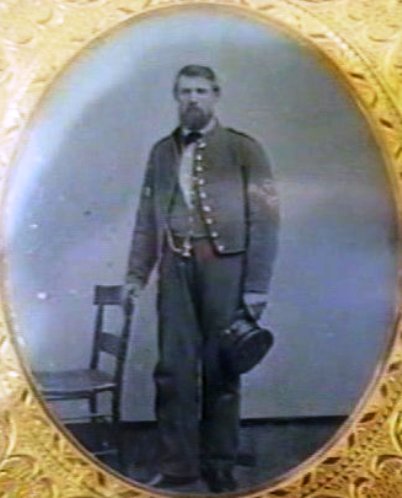
 The 1860 US Census enumerated Thomas and Hattie Virnelson and their two-year old son Clerwoode as residing in the Portsmouth, VA home of Hattie’s father, Francis C. Herbert on 20 July of that year. Thomas’ occupation was noted as “ship carpenter”. It may be assumed, and family stories support, that Thomas was employed at Gosport, the US Navy Shipyard that abutted Portsmouth City and that was located on the western shore of the Southern Branch of the Elizabeth River.
In less than a year's time life in Portsmouth, in Virginia and in the United States would change dramatically.
On 17 April 1861, Virginia became the eighth State to secede from the Union. Three days later, the Gosport Navy Yard was abandoned as the Federal forces evacuated the area. Many of the buildings and much of the equipment and stores were destroyed. Eleven ships of war were torched or scuttled and an unsuccessful attempt was made to blow up the yard’s stone dry dock.
Confederate troops began pouring into the Portsmouth and Norfolk area, and Gosport was flying a Confederate flag by 1 July 1861. During the ten months that followed, hundreds of skilled machinists and carpenters who had enlisted in the army were detailed to join the Portsmouth men already working at Gosport. The Merrimac was only one of several ironclads to be outfitted there. The yard's foundries and machine shops ran to capacity. But by the end of April 1862, the Confederate Government made the decision to evacuate the soldiers from the city. Trainloads of naval supplies were moved to Charlotte, NC and to Richmond. A convoy of vessels began to move out of the Elizabeth River and up the James River to Richmond.
The last Confederate soldier marched out of Portsmouth on 10 May 1862. Many of the workmen who had been employed at Gosport before the war followed the army to Richmond. These men found jobs at the improvised Confederate Naval Shipyard at Rocketts Landing and at the Richmond Naval Ordnance Depot.
During the summer of 1863, companies for local defense and special service were organized from men working throughout the Confederacy in government foundries, workshops and depots. Volunteers enlisted exclusively for the area in which they resided, and for the term of their residence in that area. The local defense troops were not considered as in actual service except when called for by an order of the President, and then for only as long as a specific emergency lasted. These troops were not required to operate outside of state boundaries. They received pay and subsistence while on active service. Their equipment and arms were furnished by the Confederate government.
And so it was that on 20 June 1863, Thomas Virnelson, then employed at the Richmond Naval Ordnance Depot, enlisted in Co. A, Capt. Martin Curlin’s Co, 4th(Naval) Battalion, Virginia Infantry, for Local Defense. This battalion was mustered into Confederate States service on 23 Jun 1863. Extant company muster cards indicate that Thomas was detailed into emergency service only once and that he was still employed at the Ordnance Depot in Richmond in August of 1864. Family records maintain that he attained the rank of Sergeant by the end of the War.